Explainers
Musical Work vs Sound Recording: Two Copyrights in a Song
A song and a recording of it are two separate works under US law. Who owns each, when one application covers both, and which deposit fits which.

By Antoine Duno
Updated November 19, 20267 min read
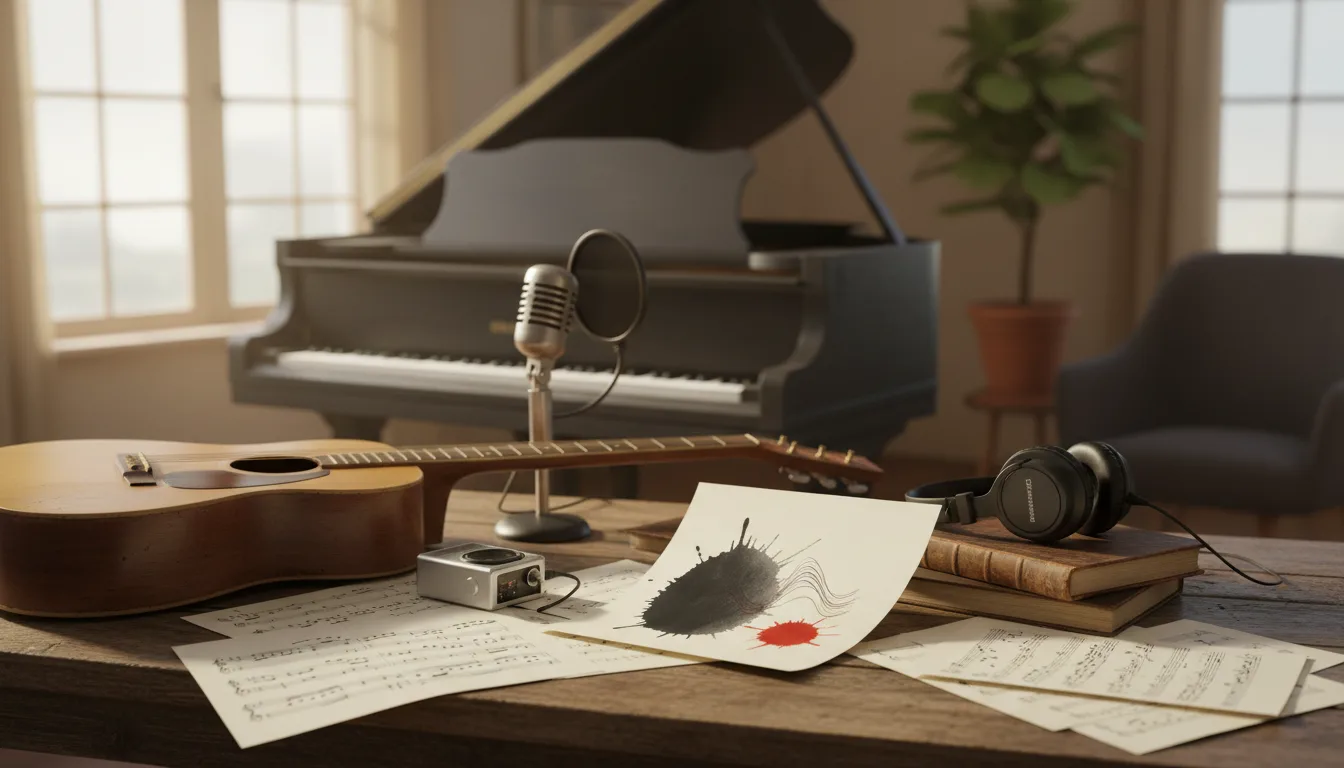
The recording of your song and the song itself are not one thing. US copyright law treats them as two works, with different authors, different owners and different deposits. Confusing them is why people upload the wrong file, or assume that recording a song gives them rights in it.
This page belongs to the songwriters series. It sits between getting a lead sheet from a recording and what deposit copy the Copyright Office accepts.
The two works side by side
Circular 56A lays the difference out as a chart. In its words, a sound recording "is a derivative work of the underlying musical composition", yet "a copyright in a sound recording is not the same as, or a substitute for, copyright in the underlying musical composition."
| Musical composition | Sound recording | |
|---|---|---|
| What is it | Music (melody, rhythm and/or harmony in notation) and accompanying words | Fixation of a series of sounds, such as a particular performance |
| Authors | Composers, lyricists, songwriters | Performers, producers, sound engineers |
| How it is fixed | A copy (sheet music, print or digital such as PDF) or a phonorecord (mp3, CD, LP) | A phonorecord (mp3, CD, LP) |
| Public performance right | Yes | Only by digital audio transmission |
The Compendium's wording on the boundary is short. The copyright in a musical work "covers the music (and lyrics, if any) embodied in the musical composition itself, but does not cover a particular recording of that composition (or vice versa)." A registration for a recording "covers the performance and production authorship involved in creating that recording, but does not cover the music or lyrics embodied in the underlying composition."
Two details matter to pianists. A recording's authors are "the performer featured in the recording and the producer who captured and processed the sounds", so if a friend played your piece and a studio recorded it, you may own the song and not the recording. And "phonorecord" is the statutory word for the object holding a sound recording, including digital files such as .mp3 and .wav. An audio file is a phonorecord, not a copy of the composition in the sense of a score.
Which application, which deposit
Circular 56A gives worked cases. This table follows them.
| Situation | Application | What the Office's examples say |
|---|---|---|
| You wrote a song and recorded it yourself | One application for both is possible; separate ones are always allowed | "The songwriter may submit one application for both the composition and recording" |
| You wrote it and someone else recorded it | The composition only | The songwriter "would submit an application for the musical composition only" |
| You recorded a song someone else owns | The recording only | The artist "would submit an application for the recording only" |
| One owner holds both, and publishes sheet music and an album | Two applications | A sheet music deposit for the composition, a recording deposit for the recording |
The one-application route has conditions. The composition and recording must be "embodied in the same phonorecord" and the claimant must be the same for both. A further, streamlined Single Application needs the author to be the only performer and the only copyright owner of both works, and Circular 56A's example deposit there is "a recording of her solo performance of the composition". You can also group up to ten unpublished sound recordings and their underlying musical works on one application, if all were created by the same authors, who are all named as claimants.
The deposit differs by work. For an unpublished musical work, Circular 50's table says to upload "one complete copy or phonorecord" where the song exists in both forms. A complete copy "is legible, is assembled in orderly form, is labeled with the title of the work, and includes everything to be covered by the registration." For a sound recording, the deposit is the recording, uploaded as a digital file (each file must not exceed 500 MB, per Circulars 56 and 56A). Once submitted, a deposit becomes "part of the public record and cannot be returned", so send a copy, not your only one.
Our page on the copyright deposit and lead sheets goes deeper on what counts as a complete copy of a song.
Where a written score fits
The Compendium says "Improvised works are not registrable unless they are fixed in tangible form, such as in a transcribed copy, a phonorecord, or an audiovisual recording." A score of your playing is one way to fix a composition. It says notation on a five-line staff is the form often employed, but "precision equal to that offered by standard notation is not required for registration, although the deposit should constitute as precise a representation of the work as possible."
What a score does not do is cover the recording. And a score covers only what it shows: Circular 50 warns not to include elements "that are not present in the copy or phonorecord".
If you try it here, keep the limits in mind. Piano to Sheet Music writes the notes you played, as a draft, from audio. It does not write chord symbols, lyrics or lead sheets, so it does not produce a complete lead sheet of a song, and it does not register or protect anything. Whether the resulting copy is a suitable deposit for your claim is a question for the Copyright Office or a lawyer.
When someone else owns the song
If you are arranging or transcribing a song you did not write, the composition belongs to someone else. Circular 50 says the copyright owner has the exclusive right to "make copies, prepare derivative works, sell or distribute copies, and perform or display the work publicly", and the same paragraph notes that the owner "may also authorize others to exercise the exclusive rights". A written arrangement for a church is that kind of copy. What licences cover it depends on the licence and the region, and we look at one in CCLI licences and arrangements. After a song is published on phonorecords in the United States, Circular 50 says others may make subsequent recordings subject to a compulsory licence, which concerns recordings, not scores.
What this page leaves out
- Other countries. All of this is US practice. For the UK, see UK song copyright proof.
- Performing rights organisations. Signing a song with ASCAP or BMI is separate from copyright registration. See whether ASCAP or BMI need sheet music.
- Fees. They change; Circular 4 on copyright.gov has the current figures.
- Whether to register at all. Circular 56 says that for sound recordings neither registration nor publication is required for protection under present law. What registration adds for you is a lawyer's question.
Frequently asked questions
What is the difference between a musical work and a sound recording?
The musical work is the composition: the music and lyrics, if any. The sound recording is a particular fixed performance of it. The US Copyright Office says they are two separate works, so a registration for one does not cover the other. Its examples are the composition Respect and a recording of Aretha Franklin singing it.
Can I register my song and my recording of it together?
Sometimes. Circular 56A says one standard application can cover both when the composition and the recording are embodied in the same phonorecord and the same person or entity is the claimant for both. Otherwise the two works need separate applications. Applicants may always choose to register them separately.
Does recording someone else's song give me copyright in the song?
No. Circular 56A's example is an artist who records a composition owned by someone else: they would apply for the recording only. Circular 50 adds that the copyright owner of a composition holds the exclusive rights to copy it and prepare derivative works. Rules for covering a song are a separate legal question.
Can a lead sheet or a recording be my deposit for a song?
For an unpublished song, either. Circular 50's table says to upload one complete copy or phonorecord where a song exists as both print copies and recordings. Circular 56A calls sheet music a copy and an mp3 or CD a phonorecord. A complete deposit includes everything to be covered by the registration.
Does a transcription of my recording protect the recording?
No. A written score is a copy of the musical work, not of the recording. The Compendium says the copyright in a musical work does not cover a particular recording of it, and the reverse. A score of your playing fixes the composition in notation; the recording remains its own work with its own claim.
Do I have to register to be protected?
Circular 56 says neither registration nor publication is required for protection of a sound recording under present law, and describes the Office's registration as a separate step. The Compendium says a musical work must be fixed in a tangible medium, such as a copy or a phonorecord. Ask the Office or a lawyer about your situation.
Sources
- US Copyright Office, Circular 50: Copyright Registration for Musical Compositions (revised 08/2023)
- US Copyright Office, Circular 56: Copyright Registration for Sound Recordings (revised 03/2021)
- US Copyright Office, Circular 56A: Copyright Registration of Musical Compositions and Sound Recordings (revised 03/2021)
- Compendium of U.S. Copyright Office Practices, Third Edition, Chapter 800: Works of the Performing Arts (sections 802.2(B), 802.4, 802.8(A), 803.2(A))
All sources read 18 September 2026.
Keep reading
How to Make a Lead Sheet From a Recording
Three ways to turn a song recording into a lead sheet of melody, chords and lyrics: by ear, with a lead-sheet app, or from a piano transcription.
14 min read
Copyright Deposit Copy: Is a Lead Sheet Enough?
The US Copyright Office names lead sheets as a deposit for unpublished songs, but only if complete. What Circular 50 and the Compendium say, quoted.
8 min read
Does a CCLI License Cover Arrangements?
Only in a narrow case. CCLI's own wording on custom arrangements, what "published version is unavailable" leaves open, and when to ask the owner instead.
8 min read
Write Down a Song You Wrote on Piano
You wrote a song at the piano and can't read music. Record it first, pick the page you need, then get the notes, chords and words down. No theory course.
9 min read
What Is MusicXML? The Format for Editable Scores
MusicXML explained from the spec: what a .musicxml or .mxl file stores, how it differs from MIDI and PDF, version 4.0, and which programs open it.
7 min read
How Accurate Is AI Piano Transcription? The Real Test
What piano transcription accuracy numbers measure, what a published model scored on the MAESTRO benchmark, and a test you can run on your own recording.
9 min read