The Journal
Featured · Comparisons
A chord chart gives lyrics and chords, a lead sheet adds the melody on a staff, and neither is a piano part. Which one each player on your team needs.
10 min read →
A digital piano can record exactly which keys you pressed as MIDI, which beats transcribing audio. Three ways to record it and how to turn it into a score.
Where AMEB lets a student play their own composition or arrangement in Piano for Leisure, what the public pages leave out, and what score to prepare.
Get your accompanist's part onto paper: why the full rehearsal take is the wrong source, recording in an echoey church hall, and the CCLI limits.
Arranging costs more than transcribing because it's creative work. 2026 per-minute rates from arranging services, and when a transcription will do.
LCM's 2026 piano syllabus drops Leisure Play, the route that allowed your own composition. What the 2021 syllabus allows until July 2027, and what's left.
Your student composed at the keyboard, not on paper. How to record it, turn it into a score, and what Trinity, ABRSM and NFMC say about who writes it.
No: MuseScore Studio opens MusicXML, MIDI and other score files, not MP3 or WAV. The routes that do get a recording into MuseScore, and which file to use.
Your team wrote the song, so no catalogue has a chart. Who owns it, which charts to make, how to build them from a recording, and CCLI registration.
MusicXML explained from the spec: what a .musicxml or .mxl file stores, how it differs from MIDI and PDF, version 4.0, and which programs open it.
What piano transcription accuracy numbers measure, what a published model scored on the MAESTRO benchmark, and a test you can run on your own recording.
What a human transcriber charges for a lead sheet in 2026: per-minute rates, minimums and turnaround from four services, worked out for a real song.
Song missing from SongSelect, or listed with no chord sheet? What CCLI says to check, when the licence lets you make your own chart, and how to build it.
What the NFMC Junior Composers Contest asks for in 2027: a PDF score with the right header, an MP3, file names, age classes and the February 1 deadline.
Turn a piano voice memo into sheet music: the recorder settings to check, how to export the audio file on iPhone, Pixel and Samsung, and what to upload.
Piano2Notes counts transcriptions, Songscription counts minutes. Plans, free tiers, exports and editing compared from both vendors' own pages.
The US Copyright Office names lead sheets as a deposit for unpublished songs, but only if complete. What Circular 50 and the Compendium say, quoted.
Trinity accepts a lead sheet or graphic score for an own composition up to Grade 5, and staff notation from Grade 6. The rules, durations and upload steps.
AnthemScore sells a desktop licence, Piano2Notes a plan or ticket packs. Prices, export formats per tier and limits, from each vendor's own pages.
One repeatable workflow for student compositions, ear learners and lesson recordings: record, transcribe, proofread, adapt, share. Exam rules included.
Each transcription plan divided by its own quota, then by what an occasional user really transcribes. Prices from each vendor's page, September 2026.
RCM's Piano Syllabus has no own-composition option. The substitutions it does allow, the published-edition rule, and the request-form deadline.
When PraiseCharts doesn't carry the song: request it, order a custom chart, or write your own from the recording, and what a CCLI licence allows.
The brief to send a music transcriber (file, timestamps, parts, format) and 7 questions to ask before paying, with terms from three services' own pages.
Three ways to turn a song recording into a lead sheet of melody, chords and lyrics: by ear, with a lead-sheet app, or from a piano transcription.
How many scores, what format, and whether MIDI recordings count: composition portfolio rules from BU, Indiana, Michigan, CMU and MSM for fall 2027.
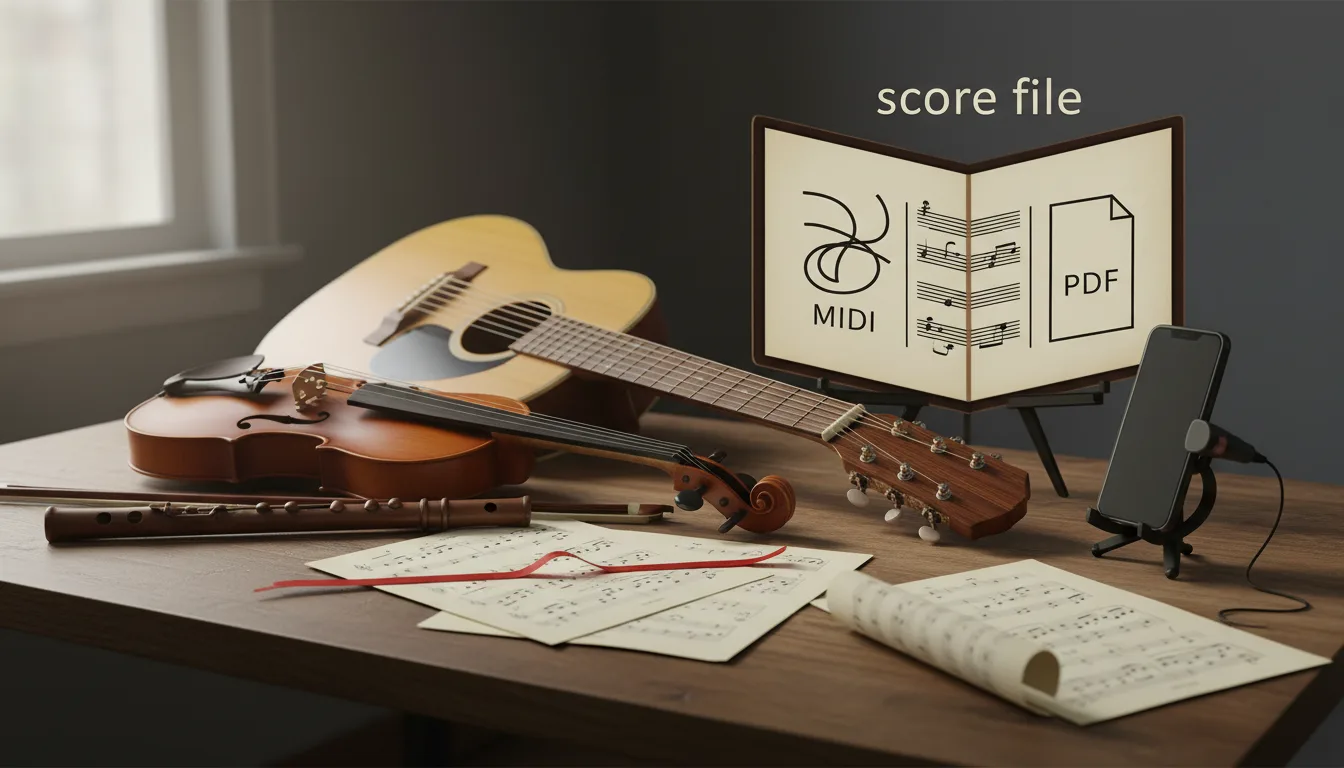
MIDI stores what was played, MusicXML how it's written, PDF how the page looks. Which file to use for printing, editing, a DAW, a band or leaving Finale.
A human transcriber charges about $75–147 for a three-minute piano piece; software, a few dollars. What each price buys, and when a draft is enough.
Songscription sells monthly minutes that expire. Piano alternatives priced per song, per pack or once, with prices from each vendor's own site.
Which piano exam boards accept your own composition, and what score each wants: ABRSM, Trinity, LCM, AMEB and RCM, quoted from the current syllabuses.
Transcription tools need an audio file, not a YouTube link — and whose video it is matters. The routes that work, for your own videos and beyond.
A Spotify stream can't be transcribed directly — it isn't a file you own, and ripping one breaches the terms. The honest routes that work.
ScoreCloud reads audio files only on Songwriter ($11.99/mo) or Pro. Piano alternatives without that plan, from one-time licences to $4.99 per piece.
Piano2Notes Pro is a subscription. The one-time, per-piece and cheaper-plan alternatives for piano, with prices from each vendor's own site.
Hit Melody Scanner's 1-minute free limit? Piano alternatives by how you pay: packs, per piece, one-time or plan, with prices from each vendor's own page.
We measured where automatic piano transcription breaks: the protocol, the onset F1 numbers on named test pieces, and six uncorrected examples.
Klangio makes Piano2Notes, Guitar2Tabs and more. Alternatives to its ticket-and-plan model, priced from each vendor's own pages.
Best piano transcription software compared honestly: AnthemScore, Piano2Notes, ScoreCloud, Melody Scanner, Basic Pitch and more, with vendor pricing.
Most transcription apps bill monthly. The free, one-time and per-piece options that don't, with prices from each vendor's site and when a plan still wins.
Samplab not working since 17 September 2026? Why logins and old versions fail, what still opens your projects, how refunds work, and where to go next.
Samplab's stated end date, 17 September 2026, has passed. What its notice says about projects and refunds, and which audio-to-MIDI tools handle piano.
You play by ear and can't read music. Here is how to get your playing written down properly anyway — for a teacher, a band, an exam, or just to keep it.
Human transcribers charge per minute of music with a minimum order. September 2026 rates from three services, compared with software.
Spotify's Basic Pitch outputs MIDI with pitch bends — no key signature, no hand splitting, no rhythmic spelling. What it takes to get a readable score.
Browser-based alternatives to AnthemScore, with prices checked on every vendor's own site — plus an honest case for AnthemScore's one-time desktop licence.
ABRSM asks for a legible, fully-notated score of your own composition. Here is the exact wording, what it means, and how to get there from a recording.
A MIDI file stores notes, not sound — so sheet music is one conversion away. What's inside a .mid file, and how to turn one into a printable score.
How to transcribe piano music by ear: find the key, map the bass and melody, fill in chords, notate the rhythm and check your work at the piano.
How to record piano with your phone for clear sound and accurate transcription: phone placement, the right settings, room tips, and mistakes to avoid.
Learn to read piano sheet music: the grand staff, treble and bass clefs, note names, rhythm, rests, and key and time signatures, for beginners.
How to turn a piano recording into sheet music: prepare the audio, convert it, check the score and fix errors. A practical piano to sheet music guide.
Audio to MIDI tools compared: Basic Pitch, Piano2Notes, Songscription, AnthemScore, ScoreCloud, Melodyne and ours, from vendor pages read Sept 2026.