Comparisons
What a Custom Piano Arrangement Costs in 2026
Arranging costs more than transcribing because it's creative work. 2026 per-minute rates from arranging services, and when a transcription will do.

By Antoine Duno
Updated October 29, 202610 min read
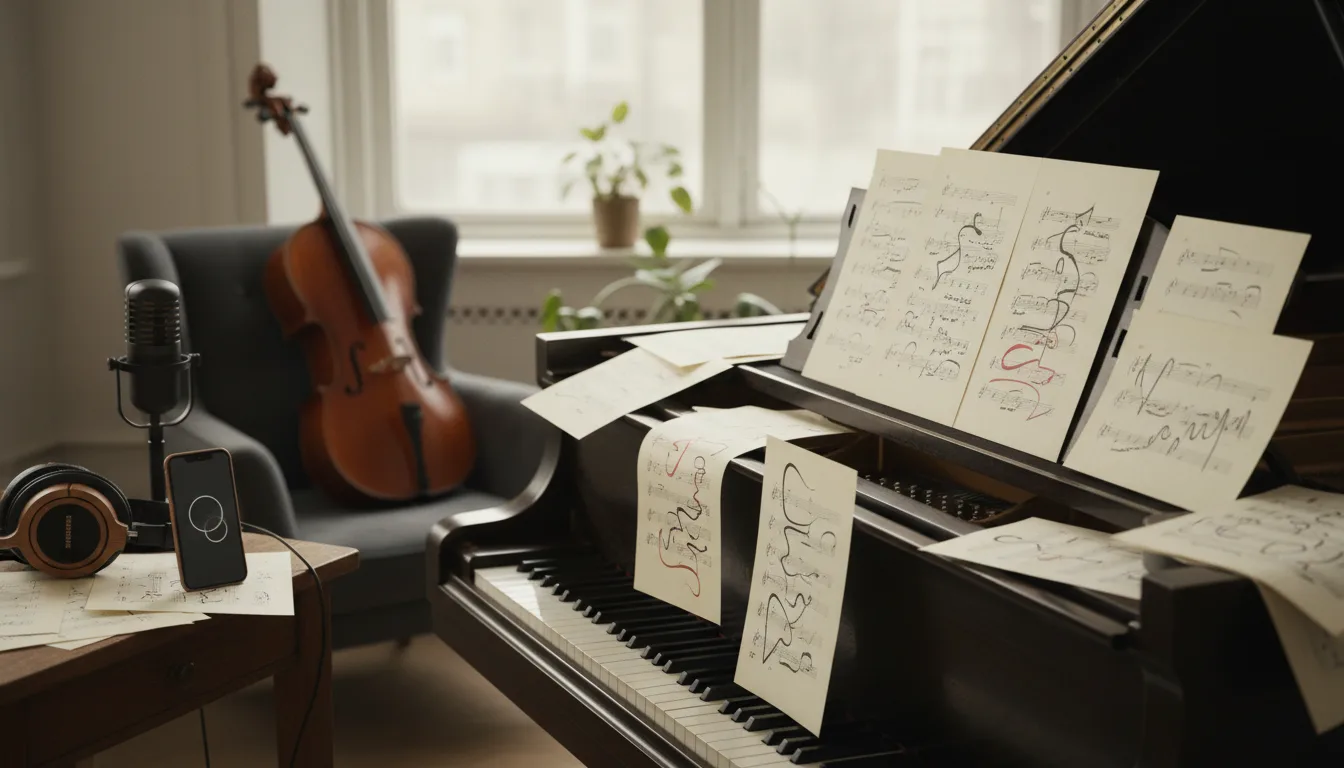
People who ask for a "piano arrangement" often mean one of two very different jobs. One is writing down a version that already exists, like the way you play a song or the piano part on a recording. The other is making a version that doesn't exist yet: turning a band song into a solo piano piece, making it easier for a student, or reharmonising a hymn. The first is transcription. The second is arranging, and it costs more because someone is making musical decisions for you.
Arranging vs transcribing: which one you're buying
| Transcription | Arrangement | |
|---|---|---|
| What happens | Writes down music that exists, as played | Creates a new version of a piece |
| Typical requests | "Write out the piano part of this recording", "Notate how I play this" | "Make this band song a piano solo", "Grade 3 version for my student", "Piano and voice in a lower key" |
| Who makes the musical decisions | The recording | The arranger, working to your brief |
| Priced by | Minute of music, difficulty | Minute of music, instrumentation, creative scope |
| Can software do it? | It can produce a first draft from a clean recording | No: software writes down what it hears, it doesn't create a new version |
| Copyright question | Writing down someone else's song still copies it; publishing or selling it raises the same permission question | An arrangement of someone else's song is an adaptation that needs the owner's permission |
The expensive mistake runs both ways. Pay arranging rates for a job that's really a transcription, and you're paying for creativity you didn't need. Pay transcription rates for a job that's really an arrangement, and you get an exact copy of a band recording that may not work as a piano piece.
2026 arrangement rates, from the services' own pages
Checked 16 September 2026. All prices in US dollars except where noted.
| Service | What's priced | Rate | Minimum and terms |
|---|---|---|---|
| Music Notation Hub | 1–2 instruments (solo, duo) | From $25/min; $25–75+/min | $49 minimum; 3–5 business days; two rounds of revisions |
| Music Notation Hub | Piano reduction or piano + vocals | From $50/min; $50–120+/min | Same |
| Music Notation Hub | 3–4 instruments | From $75/min; $75–150+/min | Same |
| My Sheet Music Transcriptions | Band and ensemble arrangements | From $30/min | Revisions, transpositions and digital formats included; custom quotes |
| PraiseCharts | Piano/Vocal Pack (lead sheet, piano/vocal, vocal only, piano only) | $250–330 | Priority fee; you also buy the finished chart; posted within two weeks |
| PraiseCharts | Piano/Vocal (SATB vocals, includes lead sheet) | $220–295 | Same |
| Canadian League of Composers | Creative arrangement, under 5 staves, standard 3–5 min song | $877, + $207 per minute over 5 minutes | Suggested minimum rates, effective 1 January 2026; currency not stated on the page |
Music Notation Hub delivers a "print-ready PDF score" as standard, and lists source files (Sibelius, Dorico, MuseScore, Finale), individual parts and an audio mockup as optional add-ons. If you want to edit the arrangement later, ask for the source file in the quote.
PraiseCharts is only for worship songs it can clear, and its arranging fee is described as a "priority fee that jumps your song to the top of our arranging queue". The chart is then sold on the site, and you buy it like any other customer. Our PraiseCharts gap guide covers when that route makes sense.
The Canadian League of Composers figures aren't a service's prices. They're a professional body's "suggested minimum rates" for composers negotiating a commission. They're a useful reference point: what a composer working to professional rates would ask for creative arranging, as opposed to what an online notation service charges. The page gives the amounts with a dollar sign but doesn't say which dollar; the League is Canadian.
Worked examples, as arithmetic
These use the listed rates only. A real quote depends on the song, and "from" rates are floors.
A 3½-minute pop song as a piano solo at Music Notation Hub's 1–2 instrument rates:
- At $25/min: 3.5 × $25 = $87.50
- At $75/min: 3.5 × $75 = $262.50, and the range says "+"
The same song for piano and voice, at its piano + vocals rates:
- At $50/min: 3.5 × $50 = $175
- At $120/min: 3.5 × $120 = $420, again with a "+"
A 90-second piece: at $25/min the arithmetic says $37.50, but the $49 minimum applies, so short pieces cost the minimum.
A creative arrangement at professional minimum rates: the Canadian League of Composers suggests $877 for a standard song under 5 staves, before its optional music-copying fee.
Compare transcription at the same services. Music Notation Hub's services list gives transcription "Starting from $18/min". My Sheet Music Transcriptions lists piano transcription at $22–24/min for easy music up to $38–52+/min for difficult. Music Transcription Service lists $20–29/min for simple music up to $50–75+/min for complex. For the rates across more services, see our breakdown of what music transcription really costs.
What pushes an arrangement quote up
The services name their pricing factors. My Sheet Music Transcriptions lists music length, "Notation complexity and difficulty of listening" and part extraction. Music Notation Hub's tiers step up by instrumentation: its piano-and-vocals rate starts at twice its solo rate, and 3–4 instruments start at three times.
In practice, a quote grows with:
- Length. Everything is per minute.
- More staves. Piano plus a vocal line, or separate instrumental parts.
- Creative scope. "Simplify for Grade 2" is a different job from "reharmonise it in a jazz style".
- Difficulty of the source. A dense recording takes longer to hear before any arranging starts.
- Extras. Source files, individual parts, audio mockups, rush delivery.
- Rights. A buyout of arrangement rights, where the service offers one, is quoted separately.
Who owns the arrangement, and can you sell it?
This is where arrangements differ most from transcriptions, and it's worth settling before you pay. We're describing what the sources say, not giving legal advice.
Arranging someone else's song needs permission. The US Copyright Office's Circular 14 lists "A musical arrangement of a preexisting musical work" as an example of a derivative work, and says: "Only the owner of copyright in a work has the right to prepare, or to authorize someone else to create, an adaptation of that work." It adds that "The unauthorized adaptation of a work may constitute copyright infringement."
Services set their own ownership terms. Music Notation Hub says that for original compositions the client retains full copyright, but for copyrighted material "Music Notation Hub retains the arrangement rights by default, with a buyout option quoted per project". PraiseCharts says that for a song you don't own, it keeps the right to sell the arrangement in its catalogue.
If you want to sell an arrangement of a copyrighted song, ArrangeMe, run by Hal Leonard, is the licensed route. Its terms (updated November 18, 2024) say an arrangement of a copyrighted work is a work-made-for-hire owned by the song's copyright owner, and that sellers earn "10% of the Sale Price in USD for COArrangements" against "50% of the Sale Price in USD for Original Compositions or PDArrangements", meaning originals and arrangements of public-domain works. ArrangeMe's blog adds that it handles print licensing, not performance licensing.
So a custom arrangement of a copyrighted pop song is, for most buyers, a private copy for your own playing or teaching. An arrangement of your own song or a public-domain piece is a different matter, and you should ask for the rights in writing.
When you don't need an arranger
You can already play the version you want. Then the arrangement exists; it's in your hands. What you need is to get it on paper. Record yourself playing it and have that recording transcribed. A human transcriber charges transcription rates, and software is cheaper still.
Software writes down what you played, pedal and all, so expect to proofread. Our comparison of AI and human transcription sets out when a draft you correct yourself is enough and when to pay a person. If you want to try it on your own playing, you can use Piano to Sheet Music.
You have a score and need it easier. Simplifying a piece you already have in notation is editing, not composing: thinning chords, dropping an octave doubling, removing inner voices. In MusicXML you can make those edits yourself in free notation software. Our guide to simplifying a piano score for a student walks through it on your own or public-domain music.
You have a handwritten arrangement. Then you need engraving, not arranging. Engraving is priced per page rather than per minute (Music Notation Hub lists it "Starting from $10/page"), and our guide to music engraving service costs compares the options.
You need ideas you don't have. New harmonies, a different style, a piano part built from a full band mix, a version at a set difficulty. That's what you're paying an arranger for, and it's worth a proper brief.
Brief an arranger in five lines
A clear brief keeps a per-minute quote from growing:
- Source: the recording or score, with timestamps if you want only part of it.
- Instrumentation: solo piano, or piano plus which voices or instruments.
- Level: the player's grade or a sample piece at the right difficulty.
- Style and key: "as the recording", or what should change.
- Delivery and rights: PDF only or source files too, parts, deadline, and who owns the result.
Frequently asked questions
How much does a custom piano arrangement cost?
Online arranging services charge per minute of music. In September 2026, Music Notation Hub listed solo or duo arrangements from $25 per minute, usually $25 to $75 or more, and piano with vocals from $50 per minute, with a $49 minimum. For a 3½-minute song that's roughly $88 to $263 for solo piano at those rates, before extras.
What's the difference between a transcription and an arrangement?
A transcription writes down music that already exists, as it's played on a recording. An arrangement makes a new version: a different instrumentation, a simpler or harder piano part, new harmonies or a new structure. Transcription is copying and arranging is creative work, which is why arranging rates start higher at the same service.
Why do arrangement quotes vary so much?
Because the job varies. Services price by length, number of instruments and difficulty, and a creative brief can mean anything from a light simplification to rewriting the harmony. Music Notation Hub's piano-and-vocals rate starts at twice its solo rate. The Canadian League of Composers' suggested minimum for a creative arrangement of a 3 to 5 minute song starts at $877.
Can I arrange a copyrighted song for piano and sell it?
Only with permission. The US Copyright Office says only the copyright owner can prepare or authorize an adaptation, and a musical arrangement is one of its examples. ArrangeMe offers licensed selling: its terms make an arrangement of a copyrighted work the copyright owner's property, and pay the arranger 10% of the sale price, against 50% for originals and public-domain arrangements.
Who owns a custom arrangement I pay for?
It depends on the song and the service's terms. Music Notation Hub says clients keep the copyright for original compositions, but for copyrighted material it retains the arrangement rights by default, with a buyout quoted per project. PraiseCharts says it keeps the right to sell an arrangement of a song you don't own. Ask before you order.
Is there a cheaper way to get a piano arrangement?
Sometimes. If you can already play the version you want, you don't need an arranger: record it and have it transcribed, which costs less per minute from a human and $4.99 per piece with software. If you need a simplified version of an existing score, editing the notation yourself is free. You pay an arranger for musical ideas you don't have.
Sources
- Music Notation Hub: Music arrangement service
- Music Notation Hub: Sheet music services and prices
- My Sheet Music Transcriptions: home page (arrangement services)
- My Sheet Music Transcriptions: pricing
- Music Transcription Service: pricing
- PraiseCharts: Arranging and transcribing services
- Canadian League of Composers: Orchestration and arranging rates
- US Copyright Office, Circular 14: Copyright in Derivative Works and Compilations
- ArrangeMe: Terms of Use
- ArrangeMe blog: Common questions about copyrighted arrangements
All prices checked 16 September 2026.
Keep reading
What Music Transcription Really Costs in 2026
Human transcribers charge per minute of music with a minimum order. September 2026 rates from three services, compared with software.
10 min read
AI vs Human Music Transcription: Cost and Quality
A human transcriber charges about $75–147 for a three-minute piano piece; software, a few dollars. What each price buys, and when a draft is enough.
9 min read
Lead Sheet Transcription Cost: 2026 Prices
What a human transcriber charges for a lead sheet in 2026: per-minute rates, minimums and turnaround from four services, worked out for a real song.
9 min read
Transcription Subscriptions: The Real Cost per Song
Each transcription plan divided by its own quota, then by what an occasional user really transcribes. Prices from each vendor's page, September 2026.
10 min read
Hiring a Music Transcriber: What to Send and Ask
The brief to send a music transcriber (file, timestamps, parts, format) and 7 questions to ask before paying, with terms from three services' own pages.
10 min read
Piano2Notes vs Songscription: Prices and Exports
Piano2Notes counts transcriptions, Songscription counts minutes. Plans, free tiers, exports and editing compared from both vendors' own pages.
10 min read