Guides
Young Composer Competitions: Preparing the Score
Name on the score or none, handwritten or engraved, live recording or MIDI: five young composer contests compared, with a checklist for each score.

By Antoine Duno
Updated November 6, 202610 min read
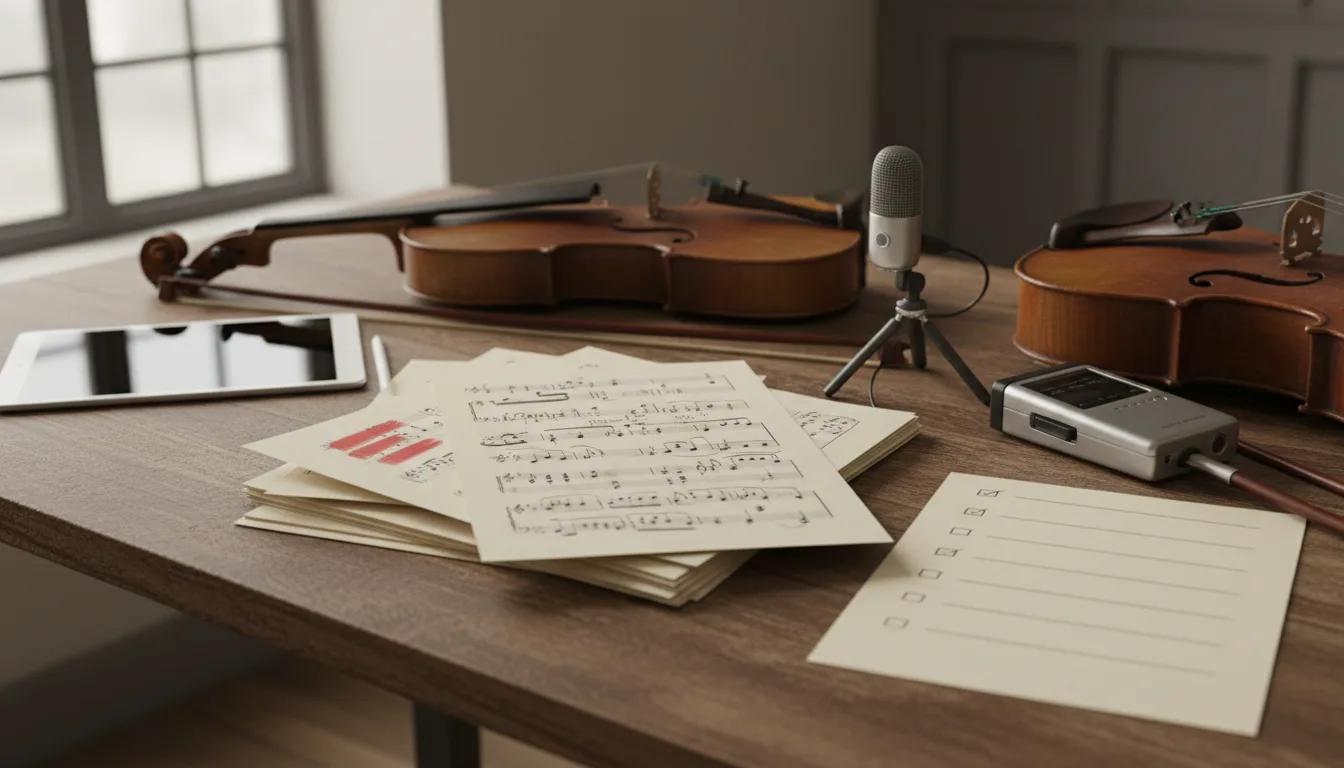
A young composer's piece gets judged on paper. Whatever the student played at the keyboard, the panel mostly reads a PDF, and each competition has its own idea of what that PDF should look like. The same score that is perfect for one contest can be disqualified from the next because it carries the composer's name.
Five competitions, side by side
These are the rules as published on each organiser's own page on 16 September 2026. Some pages still show the 2026 cycle, so dates for the next round may change; check again when entries open.
| MTNA Composition (2026–2027) | NFMC Junior Composers (2027) | BMI Composer Awards (2026 cycle) | ASCAP Foundation Morton Gould (2026 cycle) | USU Youth Conservatory Young Composer Contest | |
|---|---|---|---|---|---|
| Ages | 5–29 on January 1, 2027, in four levels | 18 and under on March 1, 2027, in four classes | Under 28 on February 15, 2026 | At least 13, under 30 on February 6, 2026 | Students of the Youth Conservatory |
| Name on the score | Title, entrant's name and level; no teacher, school or biography | Title, name, age and class, upper right of page 1 | None: "no name or any identification marks on the score beyond the title" | "All Submission materials must separately bear the Entrant's name" | Not stated for the score; files labelled with first and last name |
| Handwritten score | Not accepted | Accepted, scanned to PDF | Not stated | Not stated | "a manuscript" |
| Recording | Unlisted YouTube link: performance or notation-software sound | MP3 only | Only audio renderings from your engraving program | MP3 of an electronic realization or recording | MP3 or YouTube link |
| Other score rules | Letter-size PDF, numbered measures, no cover art, 10 minutes maximum | File named "Class #, Last name, first name, title" | Transposed or C score both acceptable | PDF and MP3 up to 250 MB | Any instruments, no length limit |
| Deadline shown | Closed September 9, 2026 | February 1 on NFMC's page; states set their own | January 15, 2026 (2026 cycle) | February 6, 2026 (2026 cycle) | Friday, March 27 |
The table shows why a single "competition-ready" PDF doesn't exist. You'll export one version per contest, and the differences are small enough to miss.
Rule one: whose name goes on the page
This is where most entries go wrong, because the instinct is to sign your work.
Anonymous: BMI. The BMI Foundation says "All works are judged anonymously" and that applicants "must submit all works anonymously, with no name or any identification marks on the score beyond the title and composition." That means more than deleting the composer line under the title. Check the header and footer, the copyright line at the bottom of page 1, and any dedication or "for my teacher" note.
Named: ASCAP and NFMC. The ASCAP Foundation's 2026 rules say the opposite: "All Submission materials must separately bear the Entrant's name." NFMC is more specific still. Its rules (JR 7-1, revised August 2026) ask for "the title, composer's name, age as of March 1, 2027, and class in the upper right corner of the first page", and our NFMC Junior Composers guide goes through that header and the file names in detail.
Partly anonymous: MTNA. MTNA's guidelines want "the name of the composition, the name of the entrant and the level" on all materials, but "The score must not include teacher name or any reference to school/institution or biography of entrant." The same rule reaches the YouTube video: the channel should be anonymous or belong to the entrant or parent, "not the teacher or studio name", and only the entrant's name and title go in the video or description.
Where names hide in a notation file
In MuseScore Studio, the handbook says the Composer and Lyricist you type in the New Score dialog fill in two places: the text on the first page, and metadata tags stored under File → Project Properties. Headers and footers can pull those tags in automatically through placeholders. So for an anonymous entry:
- Delete the composer text from the title frame on page 1.
- Clear the Composer, Lyricist and Copyright fields in File → Project Properties.
- Open Format → Style → Header & Footer and check no placeholder prints a name or copyright on later pages.
- Name the PDF file after the title, not after yourself.
- Open the exported PDF and read every page, including the last.
For the named contests, reverse it: put the name exactly where the rules say, and on NFMC's corner header, every page is the safer choice if you're unsure which wording your state uses.
Rule two: handwritten or engraved
NFMC treats both routes the same: "Composition scores may be produced and notated via a notation software application or hand notated", then "converted or scanned to PDF". A handwritten score is a real option there, as long as the scan is dark and legible.
MTNA closes that door. Its guidelines say the "PDF score must be computer generated using music-notation software" and, in a separate line, "Handwritten scores will not be accepted." MTNA also asks that "Measures of the composition must be numbered, preferably at the beginning of each system", that the PDF print on 8.5 x 11-inch letter paper, and that "Cover art should not be included." MuseScore Studio's default already numbers measures at the start of each system except the first, according to its handbook, so the default layout fits the MTNA wording; check that numbering is still on if you changed the style.
BMI's requirement for an audio rendering "generated from your music engraving program" implies you'll be using notation software for that contest anyway.
Rule three: the recording
The recording rules split into three camps.
- Software playback only. BMI: "In order to ensure an equal playing field, only audio renderings (often referred to as 'midi' files) will be accepted." A recording of a live performance isn't what it asks for. If the score includes sounds notation can't show, BMI lets you add a separate sound file.
- Either. MTNA says videos "may either be of a performance of the piece, or a sound file, generated by the music notation software". ASCAP asks for "an mp3 of an electronic realization or recording". USU's contest takes an MP3 or a YouTube link.
- Format only. NFMC says "The composition must be digitally recorded in MP3 format only" and doesn't say how.
MTNA is also explicit about how much the recording counts: "Only the PDF score will be evaluated. Recordings are used only to aid the judging process and are not considered in rankings or evaluations." And: "If there are discrepancies between the video and PDF score, only the score will be evaluated." If a judge hears a repeat that isn't written, the written version is the one being marked.
A phone voice memo won't be an MP3 by default, and a notation program's export menu is the quickest fix. The MuseScore Studio handbook lists MP3, WAV and MP4 among its export formats, so the same file that produces the PDF produces a playback MP3 or a video you can upload to YouTube.
When the piece exists only in your hands
Many young composers write at the piano and never write the piece down until a deadline forces it. The fastest honest route is to record first and notate second.
- Record a clean take on a phone close to the piano, in a quiet room, at a steady tempo.
- Get a draft score from that recording, by ear or with a transcription tool that gives you an editable MusicXML file, not only a PDF.
- Open the draft in notation software and make it say what the composer means: rhythms tidied, repeats written, dynamics, pedal and tempo added. Our guide to MIDI, MusicXML and PDF explains why the editable file is the one that matters.
- Set the page for the contest: paper size, measure numbers, and the name (or none).
- Export the PDF and the recording the contest wants, then compare them bar by bar.
Step 3 is not optional. A transcription writes down one performance; a judge reads a composition. Software can't know which repeat you meant, and dense pedalled passages come out messier than a clear texture. With Piano to Sheet Music you'd open the MusicXML in MuseScore Studio or similar, correct it, and export the contest PDF from there, since that's where you control the page.
There's also a rules question to settle first. MTNA says "AI generated compositions are prohibited" and asks the entrant to certify "the score was produced by the entrant". ASCAP's rules exclude "use of generative artificial intelligence". Neither addresses transcribing your own playing, which composes nothing. But the wording is broad enough that a student who used any software for the draft should ask the coordinator, and keep the original recording as a record of the piece.
Competitions and exams are different jobs
A competition judges the composition. An exam mostly judges the performance, and the boards have their own notation rules for playing a piece you wrote; our overview of own compositions in piano exams sets them out board by board. Older students applying to study composition will find college prescreens ask for something closer to the MTNA standard, several scores "in good manuscript form", which our guide to the college composition portfolio covers school by school.
Checklist for each contest version
- Current rules read, for this year's cycle, not last year's page.
- Name: on the score where required, removed everywhere (title, header, footer, copyright line, file name, PDF) where the contest is anonymous.
- Teacher and school: removed for MTNA, including the YouTube channel and description.
- Format: engraved if handwriting isn't allowed; letter paper and numbered measures for MTNA.
- Recording: the kind the contest accepts (software rendering, performance, or either), in the format it asks for.
- Score and recording agree: repeats, tempo, sections, ending.
- File names: the pattern the rules give (NFMC), or anonymous (BMI).
- Text: permission or public-domain proof if the piece sets words, which MTNA, ASCAP and BMI all require.
- Deadline: your state's or the organiser's current date, confirmed on its own page.
Frequently asked questions
Do young composer competitions want my name on the score?
It depends on the competition, and they point in opposite directions. The BMI Composer Awards want no name or identification marks on the score beyond the title. The ASCAP Foundation Morton Gould Awards want every uploaded file to bear the entrant's name. NFMC wants name, age and class in the upper right corner. Read the current rules before exporting.
Can I send a handwritten score to a composition competition?
Sometimes. NFMC's Junior Composers rules allow scores that are hand notated and scanned to PDF. MTNA's 2026–2027 guidelines say handwritten scores will not be accepted and the PDF must be produced with music-notation software. The ASCAP and BMI rules we read don't mention handwriting, so ask the organiser before scanning a manuscript for those.
Is a MIDI playback recording acceptable, or does it have to be live?
Rules differ. BMI accepts only audio renderings generated from your engraving program, so a live recording isn't the file it asks for. MTNA accepts a performance or a notation-software sound file, uploaded as an unlisted YouTube video. ASCAP asks for an MP3 of an electronic realization or a recording. NFMC asks for an MP3 without saying how it's made.
Does the recording affect the result?
At MTNA, no: its guidelines say only the PDF score is evaluated, recordings aid the judges but aren't considered in rankings, and where video and score disagree, only the score is judged. Other contests don't state it that plainly. Treat the score as the entry and make sure the recording matches it bar for bar.
Can I use software to turn my playing into the score?
The rules we read don't address transcription software directly. MTNA prohibits AI-generated compositions and asks entrants to certify that the score was produced by them; ASCAP excludes generative AI. A draft transcribed from your own playing isn't composed by software, but if you're unsure how a contest views it, ask the coordinator before submitting.
Sources
- MTNA: 2026–2027 Composition Guidelines
- NFMC: Junior Composers Contest Rules, JR 7-1 (revised August 2026)
- NFMC: Junior Composer Regional & State Chairmen
- BMI Foundation: BMI Composer Awards
- The ASCAP Foundation Morton Gould Young Composer Awards and 2026 Official Rules (PDF)
- Utah State University Youth Conservatory: Young Composer Contest
- MuseScore Studio Handbook: Project properties
- MuseScore Studio Handbook: Header and footer
- MuseScore Studio Handbook: Measure numbering
- MuseScore Studio Handbook: File export
Rules checked 16 September 2026. Competitions revise their rules every cycle; the organiser's current page always wins.
Keep reading
NFMC Junior Composers Contest: Score and MP3 Rules
What the NFMC Junior Composers Contest asks for in 2027: a PDF score with the right header, an MP3, file names, age classes and the February 1 deadline.
13 min read
Own Compositions in Piano Exams: Rules by Board
Which piano exam boards accept your own composition, and what score each wants: ABRSM, Trinity, LCM, AMEB and RCM, quoted from the current syllabuses.
13 min read
Composition Portfolio for College: Score Rules
How many scores, what format, and whether MIDI recordings count: composition portfolio rules from BU, Indiana, Michigan, CMU and MSM for fall 2027.
11 min read
AMEB Piano for Leisure: Own Composition Rules
Where AMEB lets a student play their own composition or arrangement in Piano for Leisure, what the public pages leave out, and what score to prepare.
11 min read
LCM Piano Own Composition: 2021 vs 2026 Syllabus
LCM's 2026 piano syllabus drops Leisure Play, the route that allowed your own composition. What the 2021 syllabus allows until July 2027, and what's left.
13 min read
Trinity Piano Own Composition: Notation by Grade
Trinity accepts a lead sheet or graphic score for an own composition up to Grade 5, and staff notation from Grade 6. The rules, durations and upload steps.
11 min read