Comparisons
Music Engraving Services: Cost of a Clean Score
Engravers charge per page, by the hour or per bar. 2026 rates from engraving services and the Canadian League of Composers, worked out for a piano piece.

By Antoine Duno
Updated November 5, 20269 min read
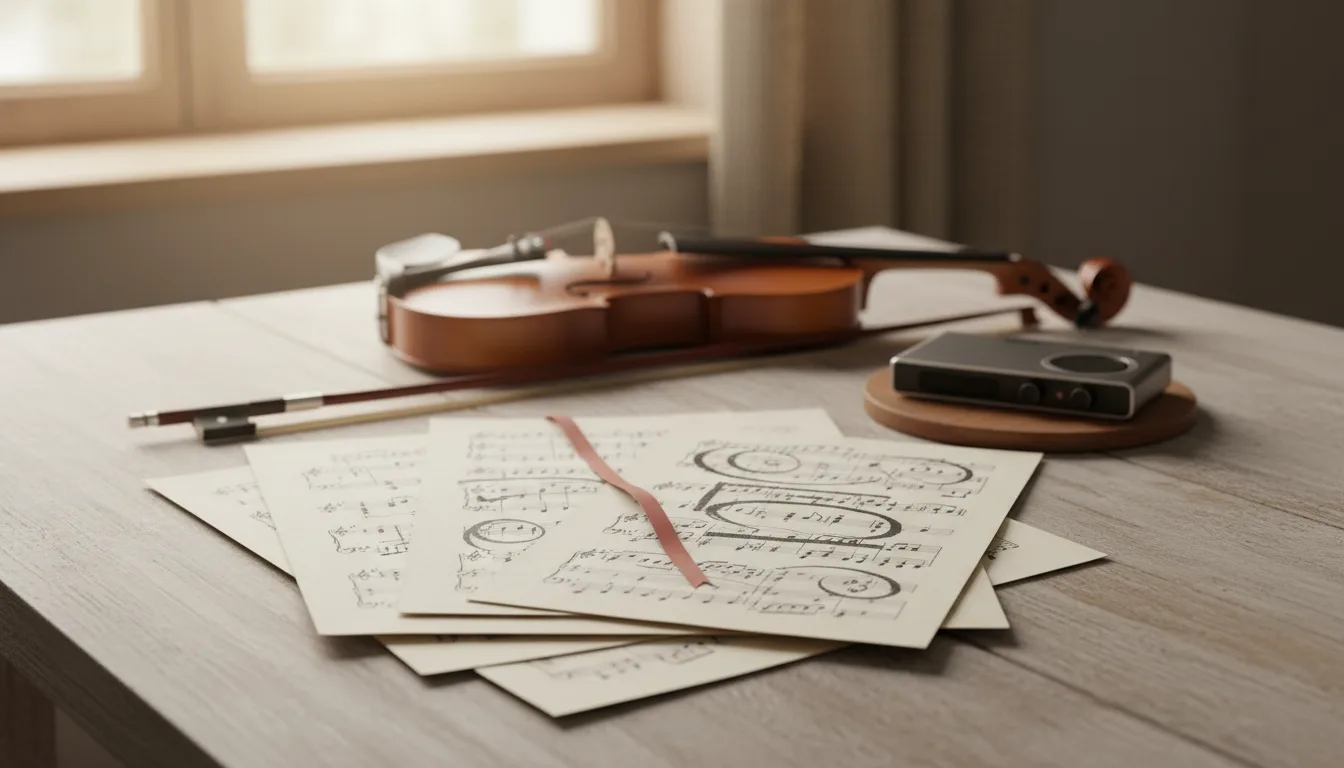
You wrote the piece. It exists on manuscript paper, in pencil, with arrows where a bar got moved, or as a rough file that prints badly. Now a competition, an application or a publisher wants a clean score. Music engraving is the job of turning that into notation that reads like a published edition, and it has its own prices, separate from transcription and arranging. This page gathers the published rates, works them out for a real piece, and covers the extras that change the bill.
Published engraving rates
| Who | How they price | Rate for a piano or small score | Terms |
|---|---|---|---|
| Music Notation Hub | Per page, by type | Piano from $14/page (typical $14–$20); single instrument from $10 (typical $10–$20); ensemble from $16; orchestral from $20+ (typical $20–$30) | $39 minimum; 2–5 business days, rush available; PDF included, editable files a paid add-on; parts extraction $5–8/page |
| J. David Moore | Per page, by staves | $12/page for 1–4 staves; $23 for 5–8; $32 for 9–12 | Quoted by contact |
| Jeremy Borum | Per page, by staves, or hourly | $12/page for 1–4 staves; $23 for 5–8; $32 for 9–12; $2/page per extra staff | $65/hour; parts from an existing score $7/page; electronic delivery |
| Canadian League of Composers (suggested minimums, CAD) | Hourly, per page by paper size, or per bar | $59/hour; $35/page for an 11 × 14" score, $48 for 11 × 17"; $0.42 per bar per voice | Effective July 27, 2025; rush pay 150% |
Rates from each page on 16 September 2026, in US dollars unless marked CAD. The CLC figures are a composers' organisation's recommended minimums for Canadian engravers, not a price list, but they come from a commissioned 2024 report and they're the only published benchmark we found.
Two things in that table matter more than the headline numbers.
"Page" isn't a fixed amount of music. The CLC is explicit: a page means "a literal full page of music, not Hollywood/Broadway jargon", and its page rates "will not apply in the case of complex notations". A dense page of piano music takes longer than a sparse one, which is why Music Notation Hub gives a typical range rather than a single figure.
The PDF and the editable file aren't the same purchase. Music Notation Hub says "Every project includes a print-ready PDF, and editable source files (Sibelius, Dorico, MuseScore, or Finale) are available as a paid add-on." Its page doesn't list the add-on's price. If you'll ever revise the piece, extract parts or reformat for a different submission, ask for the editable file in the quote.
What a piano piece actually costs
Take a six-page solo piano score from a clean handwritten manuscript: one grand staff per system, so two staves. As arithmetic, from the published rates:
| Route | Calculation | Cost |
|---|---|---|
| Music Notation Hub, piano | 6 × $14 to 6 × $20 | $84 to $120, plus the editable file if you want it |
| J. David Moore or Jeremy Borum, 1–4 staves | 6 × $12 | $72 |
| CLC suggested minimum, per bar | Say 120 bars × 2 voices × $0.42 CAD | $100.80 CAD |
| CLC suggested minimum, hourly | $59 CAD × however many hours it takes | Depends on the engraver's speed |
| Engrave it yourself in MuseScore Studio | Free software | $0, plus your hours |
The per-bar line assumes two voices a bar; the CLC counts "Multiple voices in the same measure" as additional frames, so a piano texture with more independent lines costs more by that method. Lyrics and chord names add their own per-bar amounts ($0.16 CAD per lyric layer, $0.12 CAD per chord-name layer).
Engraving from a manuscript is a different job from transcribing a recording, which human services price per minute of music; our transcription cost guide sets out those rates. The CLC's own table lists "Transcription from Audio" at $66 CAD an hour against $59 CAD for engraving. Arranging costs more again, since it's creative work; see what a custom piano arrangement costs.
What pushes the price up
Music Notation Hub lists what affects a quote: "Number of pages or staves", "Source format (handwritten vs. digital)", "Number of voices per staff", "Additional text elements (chord symbols, lyrics, etc.)", "Rush delivery needed" and "Special formatting or layout requests". In practice, for a composer:
- A hard-to-read manuscript. The same page says per-page pricing applies to "clearly written manuscripts", and that "heavily deteriorated manuscripts, experimental notation, or extensive reformatting" are quoted individually.
- Missing information. If dynamics, pedalling or articulation aren't on your page, the engraver either asks, guesses, or leaves them out. David Bailey Music Studio's engraving page, for example, lists "fixing of any mistakes which are present in the original materials sent to me" among the things its quotes do not include.
- Rush jobs. The CLC suggests a 150% rate for rush pay.
- Parts. An ensemble piece needs a part for each player. Music Notation Hub prices extraction at $5–8 a page and Jeremy Borum at $7 a page from an existing score.
- Changes after the quote. Rewriting the music mid-job means re-entering it. The CLC notes an engraver may ask for a higher rate or "some type of cutoff for free revisions" if substantial revisions are expected.
How to get an accurate quote and a smaller bill
- Finish the piece first. Engraving a draft and then revising it is the most expensive way to do this.
- Mark everything on the manuscript: tempo, dynamics, articulation, pedalling, repeats, title and your name as composer.
- Scan it well. A flat, well-lit scan or photo of every page, in order, numbered.
- Say what you need at the end: page size, whether you want the editable file, and whether parts are needed.
- Say what it's for. A competition that wants an anonymised score, or an application with its own formatting rules, changes the job. Our guide to composition portfolios for college applications covers what schools ask for.
- Ask what revisions are included and what counts as an engraver's error rather than a change of mind.
- Get the quote in writing before work starts. Music Notation Hub and David Bailey Music Studio both say they quote before work begins.
The cheaper routes, honestly
Engrave it yourself. MuseScore Studio describes itself as "Completely free, no limitations". A two-page piano piece is an evening's work for someone comfortable with notation software, and much longer the first time. Paying someone only for proofreading is a middle path; the CLC lists proofreading as its own hourly service ($57 CAD suggested minimum).
Start from a recording, if you can play it. Plenty of composers work at the keyboard, and the piece is more reliably in their hands than on the page. In that case the job is transcription from your own performance, and software can produce the first draft. Record the piece cleanly, transcribe it, open the MusicXML in MuseScore Studio, fix what's wrong, then do the layout. It's not an engraver's finished product: you correct the rhythms, hand splitting and spelling yourself, and a submission-ready layout is still your work.
That route suits solo piano pieces you can play accurately. It doesn't suit ensemble scores, pieces you can't perform, or anything where the manuscript is more exact than your playing. For those, pay an engraver. When you're ready to try it on your own music, you can upload a recording here.
If the score is going to be sold
A score for sale has to look like one, and platforms have their own file requirements. Our guide to selling your own sheet music covers where composers sell and what they need to upload. If your piece is a song, a lead sheet may be all you need to engrave; lead sheet transcription costs covers that format's pricing.
Frequently asked questions
How much does music engraving cost?
Usually per page. In September 2026, Music Notation Hub listed piano engraving from $14 a page with a $39 minimum, and two independent copyists listed $12 a page for scores of one to four staves. The Canadian League of Composers suggests minimums of $59 CAD an hour or $0.42 CAD per bar per voice. A six-page piano score lands roughly between $72 and $120 at those page rates.
What is the difference between music engraving and music transcription?
Engraving works from music that's already written down, such as a handwritten manuscript or an old PDF, and turns it into clean notation. Transcription works from audio and has to work out the notes first. Music Notation Hub draws the line that way, and the Canadian League of Composers lists transcription from audio at a higher hourly rate than engraving.
Do engraving services give you the Sibelius, Dorico or MuseScore file?
Not always by default. Music Notation Hub says every project includes a print-ready PDF and that editable source files are a paid add-on. Ask for the editable file if you'll revise the piece, need parts later or want to change the layout for a competition or application, because a PDF can't be edited in notation software.
Why do engravers charge more for handwritten manuscripts?
Because reading them takes longer. Music Notation Hub lists the source format, handwritten or digital, among the things that affect price, and says heavily deteriorated manuscripts, experimental notation or extensive reformatting are quoted individually. A neat, complete manuscript with every dynamic and articulation marked costs less than a sketch the engraver has to interpret.
Is it cheaper to engrave my own score?
In money, yes. MuseScore Studio describes itself as completely free with no limitations. In time, it depends on your speed with notation software and the piece's length. You can also enter the notes yourself and pay only for proofreading, which the Canadian League of Composers lists as a separate hourly service.
Can I get my composition engraved from a recording instead of a manuscript?
Yes, but that's transcription, which costs more from a human. If you can play the piece at the piano, recording it and transcribing it with software gives you a draft score as MusicXML to correct and lay out yourself. Piano to Sheet Music charges $4.99 per piece with no subscription; you still do the editing.
Sources
- Music Notation Hub: Music engraving and copying services
- J. David Moore: Manuscript services
- Jeremy Borum: Music preparation rates
- Canadian League of Composers: Engraving and preparation rates
- David Bailey Music Studio: Music engraving
- MuseScore Studio
All pages checked 16 September 2026.
Keep reading
What Music Transcription Really Costs in 2026
Human transcribers charge per minute of music with a minimum order. September 2026 rates from three services, compared with software.
10 min read
What a Custom Piano Arrangement Costs in 2026
Arranging costs more than transcribing because it's creative work. 2026 per-minute rates from arranging services, and when a transcription will do.
10 min read
Lead Sheet Transcription Cost: 2026 Prices
What a human transcriber charges for a lead sheet in 2026: per-minute rates, minimums and turnaround from four services, worked out for a real song.
9 min read
Transcription Subscriptions: The Real Cost per Song
Each transcription plan divided by its own quota, then by what an occasional user really transcribes. Prices from each vendor's page, September 2026.
10 min read
Hiring a Music Transcriber: What to Send and Ask
The brief to send a music transcriber (file, timestamps, parts, format) and 7 questions to ask before paying, with terms from three services' own pages.
10 min read
AI vs Human Music Transcription: Cost and Quality
A human transcriber charges about $75–147 for a three-minute piano piece; software, a few dollars. What each price buys, and when a draft is enough.
9 min read